


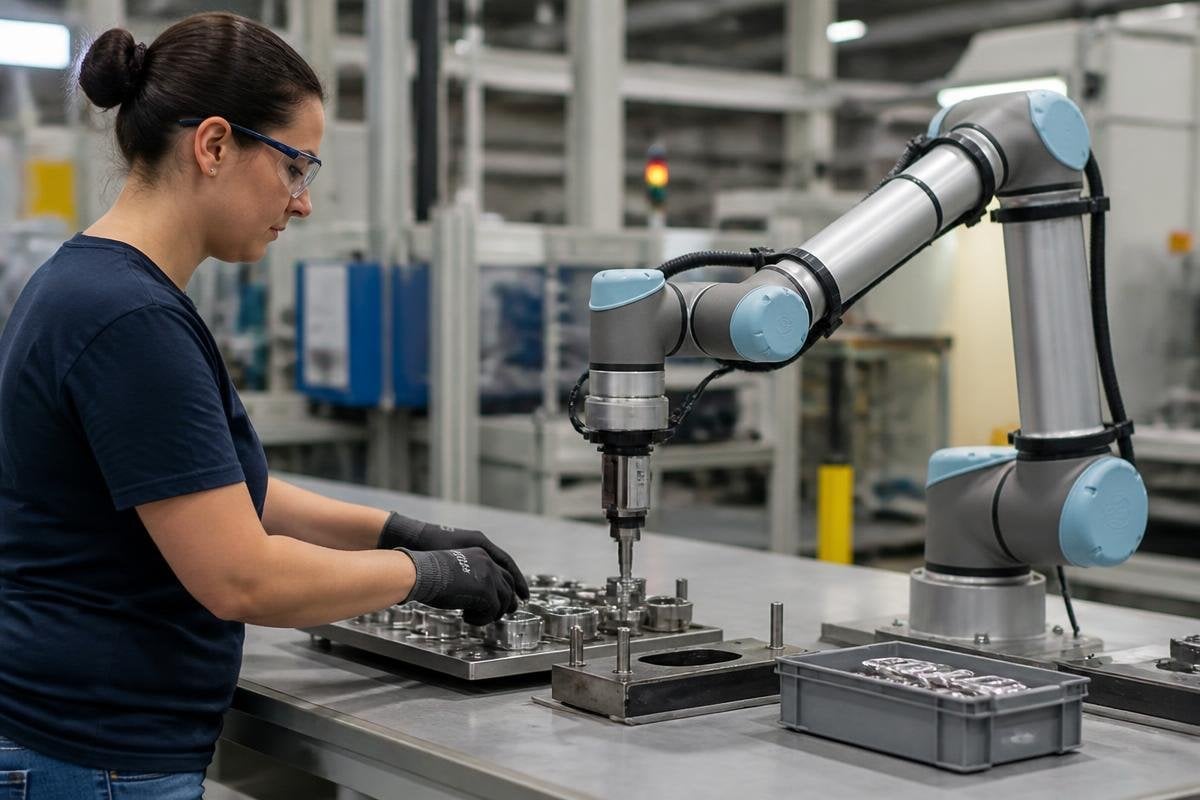
A collaborative robot can work beside a person without a full safety cage, when the risk assessment and setup support that use. That changes where automation fits: that arm can take on a repeated task at an existing workstation instead of needing a separate production cell.
- Cobots can share work areas with people when safety checks support it
- Force sensing helps a cobot stop or slow after contact
- The hard part is often the tool, task, and production setup
Where cobots fit on the factory floor
Traditional industrial robots suit fast, repeated work in controlled cells. A collaborative robot suits jobs that still need a person nearby, such as loading parts, tending a machine, placing items in trays, or applying a sealant.
That shared space matters for smaller factories. A company can keep a person on inspection or part sorting while the cobot handles the same handoff again and again. The person keeps the judgment-heavy work. The robot keeps the motion consistent.
This setup also helps when a product changes often. A fixed robot cell may need new guarding, fixtures, and program work for each product. A cobot can move between stations more easily, though each new task still needs a fresh safety review and a proper program.
How the safety system works
A cobot does not become safe because it has a friendly shape. Its safety depends on speed, force, reach, tooling, payload, workspace layout, and the part it is handling.
Many cobots use joint torque sensing or force sensors to detect contact. The controller can stop the arm when it feels resistance. Some systems also limit speed and tool force near a person. Those limits reduce risk, but they don’t remove it.
A sharp gripper, hot part, cutting tool, or heavy load can injure someone even when the arm moves slowly. A safety check must cover the full system, including the end effector, which is the tool fixed to the robot wrist.
Standards such as ISO/TS 15066 describe collaborative robot operation and limits for contact. A manufacturer can give useful data, but the factory still needs to assess its own task.
The same cobot may have a different risk level when it carries a soft suction cup instead of a metal clamp.
A metal clamp can pinch or crush where a soft suction cup may only press against a part. Robot24.com reports on factory robots and tests that place each tool beside the task, helping you judge whether a cobot’s safety claim fits the work it will do.
The work changes before the robot arrives
Poor planning rarely gets fixed by a cobot alone. Parts still need to arrive in a repeatable position. The robot needs room to reach them. The person and robot need clear handoff points.
Programming can be easier than with older industrial robots. Some cobots let a technician guide the arm through a motion or set points from a tablet. That reduces setup time for small jobs, but it doesn’t remove the need to test cycle time, part variation, recovery steps, and safe restart behavior.
The tool often decides whether the task works. A gripper must hold the part without marking it, while a suction tool needs a suitable surface and enough vacuum. If the tool slips, the cobot may stop often or place parts badly.
I’d choose a cobot when the task is repetitive, the product changes often, and a person already works nearby. I’d skip it when the process needs high speed, heavy loads, or a tool that creates a serious hazard.
Check these points before buying
Use this list before asking for a quote:
- Name the task: record the part, motion, handoff, and required cycle time
- Check the load: include the gripper, cable, part, and any force during the motion
- Review the workspace: mark reach, pinch points, hot surfaces, and walking routes
- Test the tool: check grip, part damage, sensor faults, and recovery after a drop
- Plan the changeover: measure how long a technician needs to switch products
- Price the full cell: include the robot, tool, stand, software, training, and safety work
A pilot should measure the task people actually need help with, not a polished demonstration. Track completed cycles, stoppages, changeover time, and the work a person still has to do.
What happens next
Collaborative robots are changing manufacturing by making automation fit more workstations, especially where people and machines already share a process. The useful question for your factory is specific: can this arm complete one defined task safely, at the required pace, with the part and tool you already use?
If the answer is yes, start with one station and measure it for a full production run. That result will tell you more than a robot specification sheet.
