


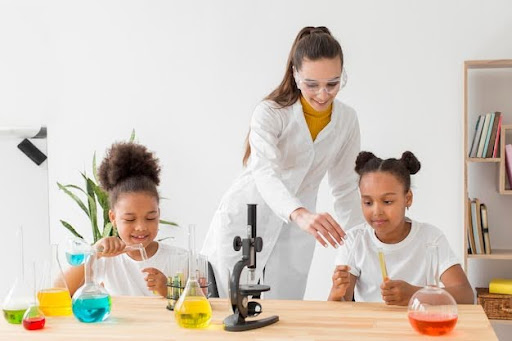
Physics training offers a hidden career advantage that goes way beyond lab work. The University of New Mexico’s Department of Physics and Astronomy did so earlier this year when they secured three NSF CAREER awards. That’s not just impressive—it demonstrates what happens when you build a discipline around hypothesis-driven inquiry, variable control, and data interpretation.
Behind those awards lies a set of habits we can all borrow.
Here’s what really matters: rigorous science education builds cognitive tools.
Professionals across different fields use these same tools to tackle complex challenges. You learn hypothesis formation. You master controlled experimentation. Data-driven feedback becomes automatic. Strategic scenario modeling? Second nature. When everything’s unpredictable and changing fast, your ability to adapt analytically becomes your silent advantage. These habits translate into real advantages across education platforms, science roadmaps, and data-driven course iterations.
And these same thinking tools don’t just live in a lab notebook—they power problem-solving from classrooms to boardrooms.
The Physics Advantage
Advanced science training offers more than just content knowledge. It provides a transferable cognitive toolkit. Hypothesis formation—plus the knack for keeping variables in check—become universal problem-framing habits that work across diverse fields.
Methodical feedback loops and comfort with uncertainty fuel iterative improvement. These four pillars underlie every successful experiment—whether you’re tweaking a lab setup, drafting a national strategy, or fine-tuning an online course. Of course, the irony is that most feedback loops work better in theory than practice—just ask anyone who’s ever tried to ‘iterate’ their way through a department meeting.
Next up: how individual learners tap this toolkit in online study environments.
Digital Study Labs
Mastering complex subjects under tight time constraints? It’s a challenge every student faces when preparing for high-stakes exams. Online revision platforms address this challenge methodically. They create structured practice environments with targeted feedback that help learners juggle study time and content complexity.
Revision Village demonstrates how this works in practice. The platform focuses on International Baccalaureate (IB) Diploma subjects—Mathematics Analysis & Approaches SL & HL, Applications & Interpretation, Chemistry, IB Physics, and Biology—plus a suite of International General Certificate of Secondary Education (IGCSE) math courses.
Over 350,000 students in 135 countries (and 1,500 schools) tap its filterable question bank, step-by-step video solutions, timed past-paper exams, and performance-analytics dashboards.
What makes it effective is structured study sessions that work as controlled problem variations. Data-driven feedback guides revisions. This builds scientific thinking in learners.
While students benefit from these controlled setups, teachers themselves are running collaborative experiments.

Collaborative Experimentation in Education
Pairing disciplines creates richer experiments in problem-solving and engagement. Teachers act as co-investigators, exploring intersections between their subjects.
Zarek Drozda, executive director of Data Science 4 Everyone, highlights the benefits of collaborative planning between math and science teachers: “We’ve seen again and again the power of giving the math and the science teacher a couple of hours to sit down together and really plan out a couple of units jointly.” This collaboration mirrors multi-variable control in physics labs and deepens critical reasoning. Though let’s be honest—getting two teachers to agree on anything usually requires more diplomacy than a nuclear disarmament treaty.
Just as classrooms harness small-scale trials, institutions apply this same experimental mindset when charting the future of science on a national scale.
Strategic Experiments on a National Stage
Getting science to serve society’s needs? Policymakers have long struggled with this. Strategic national science roadmaps offer one way forward. They create structure for long-term research investments and policy decisions.
Take the Australian Academy of Science. It’s an independent body with a Fellowship of distinguished scientists. The Academy crafts the ten-year plan Australian Science, Australia’s Future: Science 2035.
It also runs the Global Talent Attraction Program to recruit world-class researchers and recently elected eight new Fellows from the Australian Academy of Health and Medical Sciences. The Academy hosts events such as Science at the Shine Dome to recognize achievements and foster collaboration.
What’s striking is how this roadmap approach works like scientific experimentation scaled up to national level. You’ve got iterative planning. Evidence-based decisions. Peer-reviewed consultations.
These controlled planning frameworks don’t stop at traditional institutions. They’re moving into digital spaces where millions of learners become participants in educational experiments.
Digital Scale Experimentation
Delivering effective learning experiences at scale creates a significant challenge for online education providers. Data-driven A/B testing delivers a structured approach to measure and refine instructional design.
Coursera provides one example of this approach. The platform offers more than 8,000 courses, Professional Certificates, and degree programs in partnership with universities. It provides mobile and audio-only access to accommodate varied learning contexts. The company’s Chief Data Officer works on a global data strategy that includes data engineering, analytics, infrastructure, and governance to support controlled experiments.
By treating course features as parameterized variables and running controlled tests across thousands of learners, this approach replicates scientific experimentation. It drives continuous educational improvement through deliberate measurement.
Sure, A/B testing sounds sophisticated until you realize you’re essentially asking millions of people to help you figure out whether blue buttons work better than red ones.
These methodical approaches to uncertainty management reveal how creative breakthroughs emerge from controlled risk-taking.
Embracing Uncertainty and Creativity
A scientific mindset doesn’t kill innovation. It actually fuels creative breakthroughs through controlled risk-taking and uncertainty. Sure, some people think rules and analytics feel constraining. But the twist is that iterative testing trains flexibility. You can be wrong with confidence and then pivot based on what the evidence tells you.
Take professionals adapting policy programs or rewriting course modules. They’ve learned to pivot based on evidence rather than gut feelings.
This deliberate approach to managing unknowns? It becomes a competitive edge across industries. Interdisciplinary lab practices work this way. National roadmaps depend on it. Armed with these approaches, professionals across sectors can treat every problem as a hypothesis worth exploring.
That mindset shift leads us to where physics training really surfaces—in your everyday career moves.
Career Portability Across Professions
The physics-forged skillset doesn’t stay locked in the lab. It moves effortlessly into business boardrooms, legal chambers, creative studios, and policy offices. Educators use it. Policymakers rely on it. EdTech leaders build with it.
Want to put this into practice? Start simple. Take your next workplace challenge and frame it like a hypothesis you can test. Design a small experiment around it. Then use whatever data comes back to tweak your approach. These skills work everywhere because they’re really about methodical problem-solving, not memorizing formulas.
Map out your own physics-trained strengths. Maybe you’re great at breaking down complex problems into manageable pieces. Or you’re comfortable with trying something, seeing it fail, then trying again with better information.
These aren’t just lab skills anymore. They’re transferable strengths.
And if that sounds like marketing speak, consider how these practices surface again and again in real-world success stories.
From Lab to Life
From the University of New Mexico’s (UNM) NSF award winners to IB classrooms, national science roadmaps, and global learning platforms, the same practices emerge everywhere. Hypothesis, control, data, iteration. They’re not just lab techniques—they’re success patterns.
Got a stubborn problem? Think like a physicist. Don’t reach for complex equations. Test something small. Measure what happens. Adjust based on what you learn. This works for debugging code just as well as fixing a marketing campaign that’s missing the mark.
Those three NSF CAREER awards weren’t about grand visions.
They came from test, measure, and adapt. Your career can run on the same system. Don’t wait for a flash of inspiration—test your next idea like a physicist, measure the outcome, then iterate. One hypothesis at a time.
